Karachi but Haunted- The Female Gaze
- Komal Ashfaq
- Jan 16, 2023
- 4 min read
Updated: Jan 16, 2023
So. Someone sent a comment saying “add more male characters because it looks like a harem anime”. I found it so confusing that just having several female characters made that reader think about sex with waifus. To be fair, in our lifetime the default TV show cast has definitely been a majority of male characters and one or two token ladies.
It’s changing now, but to be totally honest I’ve been pretty bored with the surface level feminism I have to cringe through in grrl power movies/books/tv shows from Hollywood. “You ARE a person, you ARE a girlboss, you DO kick ass!” they all scream at me. As a person, I already know I am indeed a person. So then who are they talking to? Is TV feminism just about convincing men I am a person? Are they just talking to the guy who thinks my comic is a harem anime?
I’ve tried to tune all that noise out when I write Karachi but Haunted. Instead I’ve decided to just default to my own experiences and understanding of the world, some of which comes from living in a woman-body. I let all of it form the subtext of the story as if it’s normal.
For example, I use a lot of biologically female motifs in the comic. The underground cave interiors are all red, for both the horror setting and the vague look of a womb.
The Undead characters have to kill and eat a human being once a month, like a period but for murder. I draw lots of bloodstains on clothes.
I know in pop culture all that stuff makes people feel weird and squeamish, but for me it’s normal stuff in my normal body.


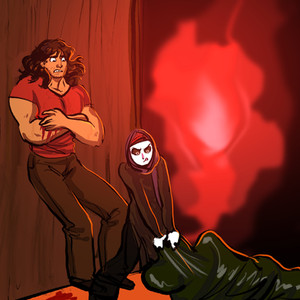
I find “beauty” is a hyperfocus of the cultural female identity, so I like to ignore it and instead I like drawing body horror or ugly and frightening female forms. Outside of the horror genre, most female characters who transform into something else/some other form tend to get prettier. So much of TikTok is a regular looking girl swiping her hand and suddenly being hot/dressed up. I think maybe I'm just contrarian. I like that in the horror genre you just descend into a monstrosity.


I don’t like the “perfection” expected of our hair, makeup, clothes and bodies in real life or in female character design, so I like to ignore that too. I like to draw Sabeen’s hair a mess, and everyone’s clothes as non-decorative as possible. When a character seems decorated/dressed up, like Anza or the Sky One, I like to keep it status-related to indicate these are important characters rather than make it seem like prettiness for the sake of prettiness.
I know lots of women enjoy the process of feeling pretty, perfect and made-up and sometimes I do too. But I can't help but think if I wasn't taught so much about how important my attractiveness was, I wouldn't care much. So I try to avoid caring about it in a story set in a world I designed.


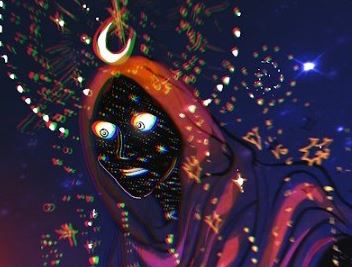
Zafar is an interesting character for me to write, because he’s based on lots of men I know in real life, rather than the usual masculine-hero-type that honestly I’ve never really met.
A little more subtly, unlike the other monsters who sort of hide away, Zafar is unafraid and confident about his presence anywhere, in a public or private space, because I thought men have a little more freedom of mobility in Karachi. They hang out anywhere, in street corners, at 3 am, late nights at dhabas, leaning on cars in apartment parking lots, playing cricket at midnight on an empty road. So it made sense to me that he comes and goes anywhere, that I would be a bit afraid of going to.

And, the reason I add all those female-experience-related things in the comic as a VIBE under everything, is because that’s how I kind of live life as someone who accidentally happened to be born a woman. I think it’s normal to have that filter, or “gaze” and just let it be part of the story.
I think, both men and women would find those parts of the story neutrally fascinating, just as a kind of perspective, the same way we’ve watched male-motif, male-centric stories our whole lives without anyone trying to convince us a man is a normal human being. We just took it for granted that a man’s perspective is normal, as if its not gender-related, just standard human.
Karachi is a messy subject to do this all for, because the man is the “default human” here if that makes sense. It’s mostly men in the streets, and men in the offices, and men in politics. Public buses have small special ladies’ sections, mosques have small special ladies’s sections, gyms have small special ladies’ sections. Karachi sometimes teaches you to think that women’s public presence is small and special and unusual and unnatural.
So, instead of the small/special/non-default/secondary-being of Karachi, and the kickass-girlboss-mary-sue of the West, I like to just write as a person, who happens to be woman. And I hope people enjoy that perspective.

Comments